Welcome to a new Voltlog today we are taking a closer look at this inexpensive speech synthesis module. The part number is XFS5152CE and we do find a datasheet for this chip but unfortunately it is all in Chinese. The datasheet contains schematic examples, they show you how to wire a microphone pre-amp, how to wire an audio amplifier, they also give you some code examples but most of the text is in Chinese.
I found this online doc translator service which worked surprisingly well, it translated my document and kept most of the formatting intact. So now I have a translated datasheet which I will link in the description below and I will also place a link to places where you can buy this module and also where you can buy just the chip.
A viewer sent in a Polycom CX600 IP Phone and a Jabra 410 Speaker for a teardown and a teardown I did. The phone has this TI TNET series system on chip, I couldn’t find any info on that but it looks like it may contain an ARM11. The speaker interestingly contained a bluetooth chip even though it doesn’t have a bluetooth feature but an explanation for that is given in the video.
In this video we are taking a closer look at the Hao QI Xin LRC Reference Box which contains a couple of polystyrene capacitors, a vishay precision resistor and an un-marked inductor. I also talk about getting the AD584 voltage reference box, however it is hard to find the LH version as most seller will be sending you the KH version which is a lower grade of stability.
In this video I am taking a look at the USAMS 3 Port USB Charger With Display. Turns out the same charger is sold under many different names, and I suspect inside there is the same circuit labeled USB320G.
Like I mentioned in the past China is improving the designs of these charger each year so the situation is much better now than it was a few years back. There would still be the $2 death traps disguised as apple chargers but in the $10 range you can get some pretty decent chargers with adequate protection. This charger has the required protection features to make it safe to use however its not special in any way, the noise level is higher than I would like and the output current of just 3A is not enough for charging 3 devices. Not even 2 at the same time if they both require more current.
This is a review of the Pirl charger which has 4 independent USB ports each capable of up to 2.7A continuous output. The product will launch on kickstarter soon.
You get 4 ports each capable of 2.7A and we’ll put that to a test later. The 4 ports are independent so a fault on one of the ports is only gonna shut down that port. It has input reverse polarity protection, thermal protection and ESD protection. It can also detect and optimize the charging current based on the connected device so I expect to see one of those tiny chips which handles the usb data lines on each port.
Another interesting feature they mention on their website is voltage compensation such that each channel adjusts the output voltage according to the current drawn, if the current increases the voltage will increase slightly to compensate for the voltage drop that might occur in the cable up to your device.
They also have a wattmeter on the front of the device showing you how much power your device is pulling from the charger.
Get your account ready because here comes a new InTheMail and there is a good chance of finding something to order in this video. Don’t forget to use the links below to find the items shown in the video.
Welcome to a new voltlog, today we’re going to test a range of pocket multimeters by applying transient voltages to their inputs and we’re also going to talk a bit about CAT ratings and what they mean.
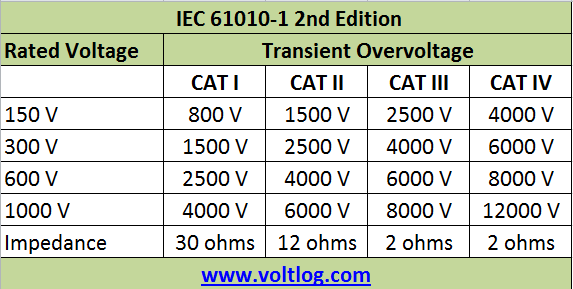
CAT ratings is something we often see marked on measurement tools and they refer to the measurement category, a method of classification published by IEC (the International Electrotechnical Commission). Different types of circuits will require a different measurement category based on the total energy available in that circuit. For example:
CAT I: is for measurements performed on secondary circuits not directly connected to mains.
CAT II: is for measurements performed on local electrical distribution, such as that provided by a standard wall outlet 110VAC in the US or 240VAC in the EU.
CAT III: is for measurements performed on hard wired building installation, for example distribution boards, circuit-breakers, bus-bars, junction boxes and industrial equipment.
CAT IV: is for measurements performed on the source of the low voltage installation, like the power input to your home, your electricity meter or the primary overcurrent protection device.
As you can see a higher CAT number refers to a circuit with higher available power and higher potential energy transients. Within each of these categories we have voltage ratings and a higher voltage rating means the ability to withstand a higher transient.
Welectron.com which is an authorized Brymen distributor, loaned me the BM887 Insulation Multimeter to perform some testing on the pocket meters. I will be using this meter to apply 1KV to the pocket meters and see how they survive. The BM887 is made for measuring insulation resistance in industrial machines, certainly not for testing multimeter input protection but we can think of it as an abnormal voltage spike that might come rushing through a circuit you are measuring.